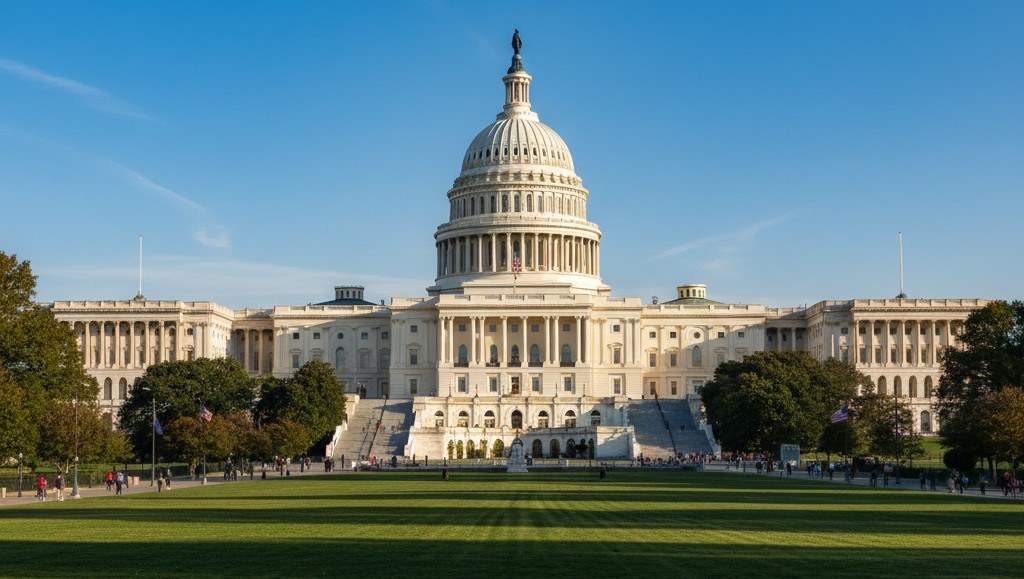
[Mexico—Correspondent Shim Young-jae] The U.S. Senate is set to hold a procedural vote to advance the CLARITY Act, a bill aimed at regulating the digital asset (virtual asset) market. While market forecasts are mixed regarding the bill’s chances of passing, analysts suggest that Ethereum (ETH), Solana (SOL), and XRP could benefit relatively from the bill’s progress.
The U.S. Senate is scheduled to vote on a cloture motion for the CLARITY Act on the 15th (local time). If the cloture motion passes, deliberations on the bill will proceed, bringing it one step closer to a final vote. However, the passage of this vote alone does not guarantee the enactment of the CLARITY Act.
50% Chance of Passage… Bitcoin Forecast at $90,000
Tim Sun, a senior researcher at Hashkey Group, told CoinDesk that he estimates the likelihood of this procedural vote passing at about 50%.
“Currently, the likelihood of the procedural vote passing is about 50%, like a coin toss, and the probability of the bill actually becoming law by the end of the year is less than 20%,” Sun said.
Lacey Zhang, a research analyst at Bitget Wallet, also noted that market participants are not building positions based on the assumption that the Clarity Act will definitely pass.
TDX Strategies, a quantitative digital asset trading firm, predicted that Bitcoin would react strongly if the motion to end debate passes.
In its daily report, TDX Strategies analyzed, “If there is an unexpected ‘yes’ vote, Bitcoin will see an aggressive upward move, breaking through the key resistance level of $82,000 and targeting $88,000 to $90,000.”
Conversely, they predicted that if the vote fails, Bitcoin could correct down to $73,000.
However, Researcher Seon and Analyst Jang noted that Bitcoin may lag behind other digital assets in terms of relative gains resulting from the bill’s progress.
This is because Bitcoin already has a relatively well-established regulatory status, access to exchange-traded funds (ETFs), and infrastructure for institutional investors.
Analyst Jang identified Ethereum as the asset most likely to benefit relatively. He explained that while regulatory uncertainty still surrounds Ethereum, it serves as the payment layer for stablecoins, decentralized finance (DeFi), and tokenized assets.
Researcher Seon stated, “If today’s procedural vote passes smoothly, digital assets such as Bitcoin and Ethereum are highly likely to show an immediate and direct positive reaction,” adding, “Subsequently, the market will begin to seek out assets that stand to benefit substantially from the evolving regulatory framework.”
Solana and XRP Could Also Benefit… Uniswap and Aave Also Draw Attention
Researcher Sun analyzed that Solana and XRP could also benefit if the Clarity Act moves forward.
He explained that if the jurisdictional boundaries between the U.S. Securities and Exchange Commission (SEC) and the Commodity Futures Trading Commission (CFTC) are clarified, it could improve conditions for institutional investor access, the launch of related products, and long-term capital inflows.
Analyst Jang predicted that XRP could react strongly. However, he noted that some of the optimism surrounding regulatory clarity has already been priced in.
According to CoinDesk, Analyst Jang and Researcher Seon analyzed that if the Clarity Act clearly defines protective measures for non-custodial software developers and decentralized protocols, Uniswap (UNI) and Aave (AAVE) could exhibit higher price sensitivity.
However, Analyst Jang emphasized that today’s vote is not the final passage of the bill but rather a procedural step to determine whether to end debate.
He explained that if prices spike briefly after the vote and then fall again, it could be attributed to short-term trading in response to the news.
On the other hand, he analyzed that for a sustained price revaluation driven by regulatory changes to occur, Ethereum must show stronger momentum than Bitcoin. He added that it is also necessary to confirm whether the bullish trend in Uniswap and Aave continues and whether spot trading volume increases relative to leveraged futures. He also noted that this trend must persist over multiple trading days.
Fed Interest Rate Decision Also a Variable… Bitcoin Tests 50-Week Moving Average
Researcher Seon also identified the macroeconomic environment as a key variable. He warned that if the Federal Reserve (Fed) raises interest rates on the 16th, the positive regulatory effects stemming from progress on the Clarity Act could be offset by liquidity tightening.
Bitcoin is also at a technically significant price level. According to CoinDesk, Bitcoin has struggled to sustain an upward trend above the 50-week simple moving average (SMA) for three consecutive weeks.
According to Galaxy Research analysis, the 50-week moving average has served as a price level that has capped the upside of every bear-market rally since last November.
Galaxy Research analyzed that if Bitcoin fails to break above the 50-week moving average this time as well, new selling pressure could emerge, potentially causing the downward trend to accelerate rapidly.
Consequently, the Senate vote on the Clarity Act will take place at a time when Bitcoin is positioned at a technically significant price level.